What Is Real Estate Professional Status (REPS)?
Real Estate Professional Status (REPS) is an IRS tax designation under IRC Section 469(c)(7) that allows qualifying taxpayers to treat rental real estate losses as non-passive. This means rental losses — often driven by depreciation — can be used to offset active income like W-2 wages, business profits, and other ordinary income.
Without REPS, rental income is classified as passive by default under IRC Section 469. Passive losses can only offset passive income, which means most rental property losses get suspended and carry forward — providing no immediate tax benefit.
REPS changes that equation entirely.
Why REPS Matters for Real Estate Investors
For real estate investors with high-earning W-2 jobs or business income, REPS is one of the most powerful legal tax strategies available. Here's a simplified example:
Say you earn $250,000 in W-2 income and own rental properties that generate a $50,000 paper loss (mostly from depreciation). Without REPS, that $50,000 loss is suspended — it can't reduce your tax bill this year. With REPS, that $50,000 loss directly offsets your W-2 income, potentially saving $15,000–$18,000 in federal taxes.
Beyond offsetting income, qualifying for REPS can also help you avoid the 3.8% Net Investment Income Tax (NIIT) on rental income and potentially qualify for the 20% Qualified Business Income Deduction (QBID).
How to Qualify for Real Estate Professional Status
To qualify as a real estate professional, you must meet both of the following requirements in the same tax year, as outlined in IRS Publication 925:
1. The 750-Hour Test
You must perform more than 750 hours of services during the tax year in real property trades or businesses in which you materially participate.
Qualifying real property trades or businesses include: development, redevelopment, construction, reconstruction, acquisition, conversion, rental, operation, management, leasing, and brokerage.
2. The More-Than-50% Test
More than half of all the personal services you perform across all trades and businesses during the tax year must be in real property trades or businesses in which you materially participate.
This is the test that makes REPS difficult for people with full-time W-2 jobs outside of real estate. If you work 2,000 hours at a non-real-estate job, you'd need over 2,000 hours in real estate to pass this test — which is extremely challenging.
Important: Both tests must be met by the same taxpayer. If you're married filing jointly, one spouse must individually satisfy both requirements. However, you can count your spouse's participation hours toward the material participation tests for each property (more on that below).
Material Participation: The Third Requirement
Qualifying as a real estate professional gets your rental activities reclassified — but you also need to materially participate in each rental activity (or elect to group them). Material participation is covered in detail on our Material Participation Tests page.
In short, you must meet at least one of seven IRS tests for each property. The most common ones real estate investors use are:
The 500-Hour Test: You participate in the activity for more than 500 hours during the year.
The Substantially-All Test: You do substantially all the work in the activity yourself.
The 100-Hour / No-One-More Test: You participate for more than 100 hours, and no one else (including property managers) participates more than you.
The Grouping Election
If you own multiple properties, proving material participation in each one separately can be burdensome. Under IRC Section 469(c)(7)(A), you can elect to treat all your rental real estate interests as a single activity. This means you only need to prove material participation once for the combined total.
This election is made on your tax return and is generally irrevocable, so work with your CPA before making it.
What Counts Toward REPS Hours (and What Doesn't)
Hours That Count
Negotiating leases and rental terms
Supervising repairs and renovations
Managing tenants (screening, communication, resolving issues)
Performing or coordinating maintenance
Property inspections and walk-throughs
Advertising vacancies and showing units
Purchasing materials and supplies for properties
Handling bookkeeping and financial management for properties
Travel time directly related to property management (e.g., driving between properties)
Hours That Generally Don't Count
Reviewing financial statements in a non-managerial capacity
General market research not tied to a specific property
Education time (courses, podcasts, reading)
Arranging financing
Tax preparation and strategy (these are investor-level activities)
The IRS and Tax Court draw a clear line between work activities (hands-on property management) and investor activities (research, strategy, financial review). Only work activities count.
The Spouse Strategy
One of the most common REPS strategies for high-income households is having one spouse qualify. If one spouse does not work outside the home or works part-time, they can more easily meet the 750-hour and more-than-50% tests.
Key rules for spouses:
REPS qualification: Each spouse must qualify independently. You cannot combine hours to meet the 750-hour or 50% tests.
Material participation: Hours from either spouse count toward the material participation tests for each property. This is a critical distinction.
Filing status: You must file jointly to use your spouse's material participation hours.
Why Documentation Is Critical
The IRS frequently challenges REPS claims, and the documentation standard is high. The Tax Court has repeatedly rejected "ballpark estimates" and after-the-fact reconstructions of hours (see Hill v. Commissioner, T.C. Memo 2010-200 and Gragg v. United States, CA9).
What the IRS expects:
Contemporaneous records — logs created as you work, not reconstructed at year-end or during an audit
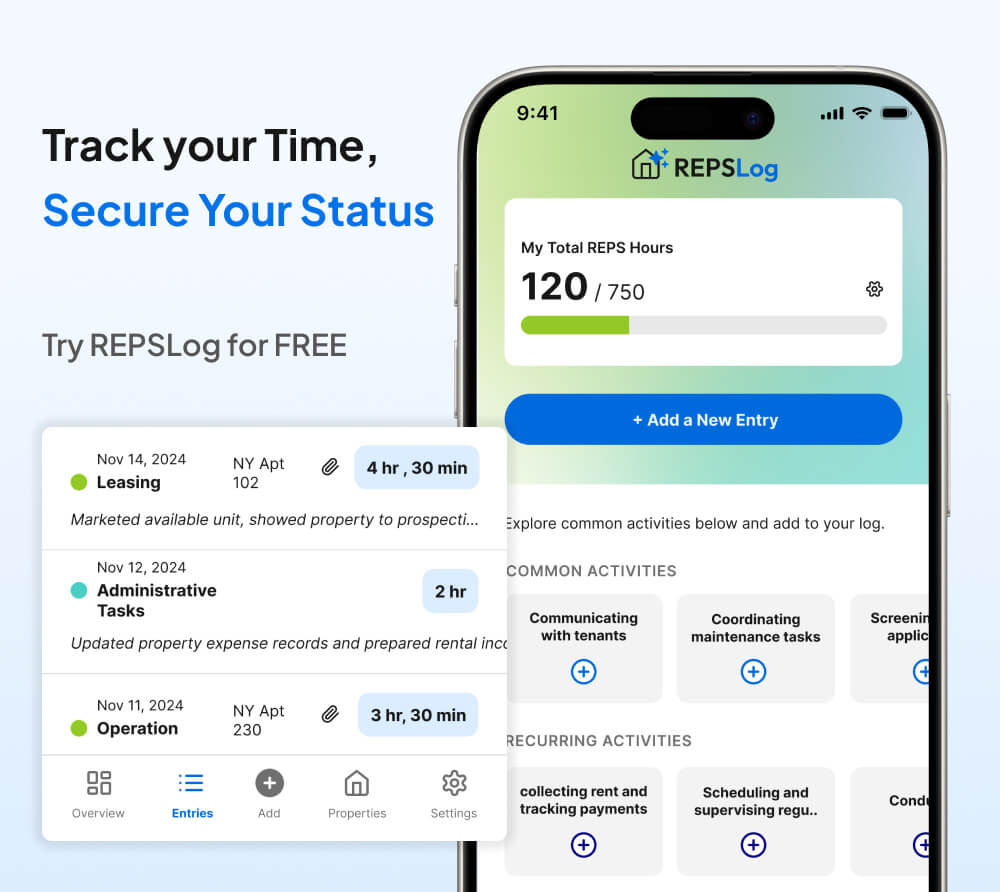
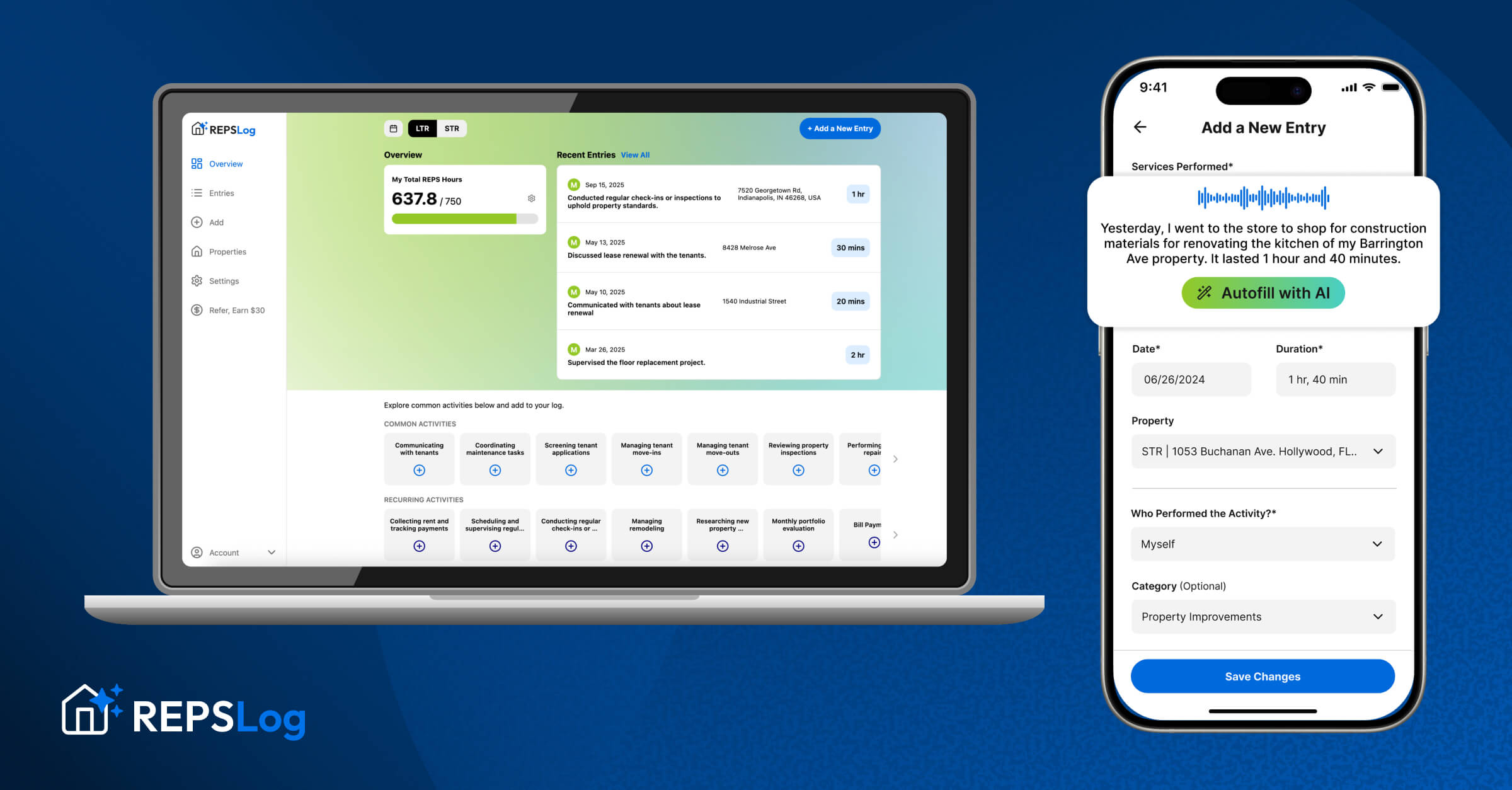
Specific entries — each entry should include the date, hours worked, property involved, and a description of what you did
Supporting evidence — receipts, invoices, emails, photos, and contractor communications that corroborate your log
Participant tracking — if others (spouse, cleaners, property managers) also work on the property, log their hours too to demonstrate you participated more
Without proper documentation, even if you genuinely worked the hours, the IRS can — and often will — disallow your REPS deduction.