The 7 Material Participation Tests
for Real Estate Investors
Material participation is one of the most important tax concepts for real estate investors. It determines whether your rental activity is classified as passive or non-passive — and that classification directly controls whether you can use rental losses to offset your W-2 income, business profits, or other ordinary income.
The IRS defines material participation as involvement in an activity on a "regular, continuous, and substantial basis." Rather than leaving that vague, they created seven specific tests under Treasury Regulation §1.469-5T(a). You only need to pass one test to qualify as materially participating in an activity.
Why Material Participation Matters
By default, the IRS treats all rental real estate as passive under IRC Section 469. Passive losses can only offset passive income — not your salary or business income.
There are two exceptions that allow rental losses to become non-passive:
Real Estate Professional Status (REPS): You qualify as a real estate professional AND materially participate in your rental activities. This works for long-term rentals. Learn more about REPS →
The STR Loophole: Your short-term rental has an average guest stay of 7 days or fewer, AND you materially participate. Learn more about the STR Loophole →
In both cases, material participation is the key that unlocks non-passive treatment. Without it, your losses stay trapped.
The 7 IRS Material Participation Tests
You must meet at least one of these tests for each activity (or for your grouped activities, if you've made a grouping election) during the tax year.
Test 1: The 500-Hour Test
You participated in the activity for more than 500 hours during the tax year.
This is the most commonly used test and the most straightforward to prove. At roughly 10 hours per week, it's achievable for investors who actively manage their properties. Hours from both spouses count when filing jointly.
Test 2: The Substantially-All Test
Your participation constituted substantially all of the participation in the activity by all individuals, including non-owners.
This test works well for investors who do everything themselves — no property manager, no co-host, no significant contractor involvement. If you handle tenant communication, repairs, bookkeeping, maintenance, and turnovers yourself, you likely meet this test.
Test 3: The 100-Hour / No-One-More Test
You participated for more than 100 hours during the year, AND no other individual participated more than you.
This is the most popular test for STR owners. At about 18 minutes per day, the 100-hour threshold is very achievable. The critical part is the second half: you must spend more time than any single other person — including cleaners, property managers, and co-hosts.
This is why tracking everyone's hours matters, not just your own.
Test 4: Significant Participation Activities
You participated in the activity for more than 100 hours, the activity is a "significant participation activity," and your total participation across all significant participation activities exceeds 500 hours.
This test is useful for investors who own multiple properties and spend between 100–500 hours on each. If the combined total across all your significant participation activities exceeds 500 hours, each activity is treated as non-passive.
Test 5: The Prior-Year Test
You materially participated in the activity for any 5 of the prior 10 tax years.
This test is less common for rental investors but can apply to those with a long track record of participation. The 5 years don't need to be consecutive.
Test 6: The Personal Service Activity Test
The activity is a personal service activity, and you materially participated in it for any 3 prior tax years.
This test applies specifically to personal service activities (health, law, engineering, etc.) and rarely applies to rental real estate investors.
Test 7: The Facts and Circumstances Test
Based on all the facts and circumstances, you participated in the activity on a regular, continuous, and substantial basis during the tax year.
This is the catch-all test, but it's the hardest to rely on. The IRS has strict limitations: you cannot use this test if you participated for 100 hours or fewer, and it cannot be used if there is paid on-site management. Tax Courts rarely rule in favor of taxpayers using this test alone.
Which Test Should You Use?
For most real estate investors, Tests 1, 2, and 3 are the most relevant:
You self-manage and spend significant time → Test 1 (500 hours)
You do all the work yourself, no outside help → Test 2 (Substantially all)
You self-manage an STR with cleaners/contractors → Test 3 (100 hours, more than anyone else)
You own multiple properties with moderate time in each → Test 4 (Significant participation, combined 500+ hours)
You've been managing properties for many years → Test 5 (5 of prior 10 years)
You can use a different test for each property. And if you've made a grouping election (treating all rentals as one activity), you only need to pass one test for the combined activity.
How Spouse Hours Work
This is one of the most important — and most misunderstood — rules in material participation:
Your spouse's participation hours count as yours for material participation purposes, even if your spouse has no ownership interest in the property and even if you file separately (married filing separately).
Example: You spend 220 hours managing a rental property. Your spouse spends 320 hours coordinating repairs and handling tenant issues. Combined, you have 540 hours — passing Test 1 — even if only you are on the deed.
However, for REPS qualification (the 750-hour and 50% tests), each spouse must qualify independently. Spouse hours do NOT count toward those tests.
Documenting Material Participation: What the IRS Expects
The IRS doesn't technically require a specific format for proving material participation. Treasury Regulation §1.469-5T(f)(4) states that participation "may be established by any reasonable means." Contemporaneous daily time reports are "not required."
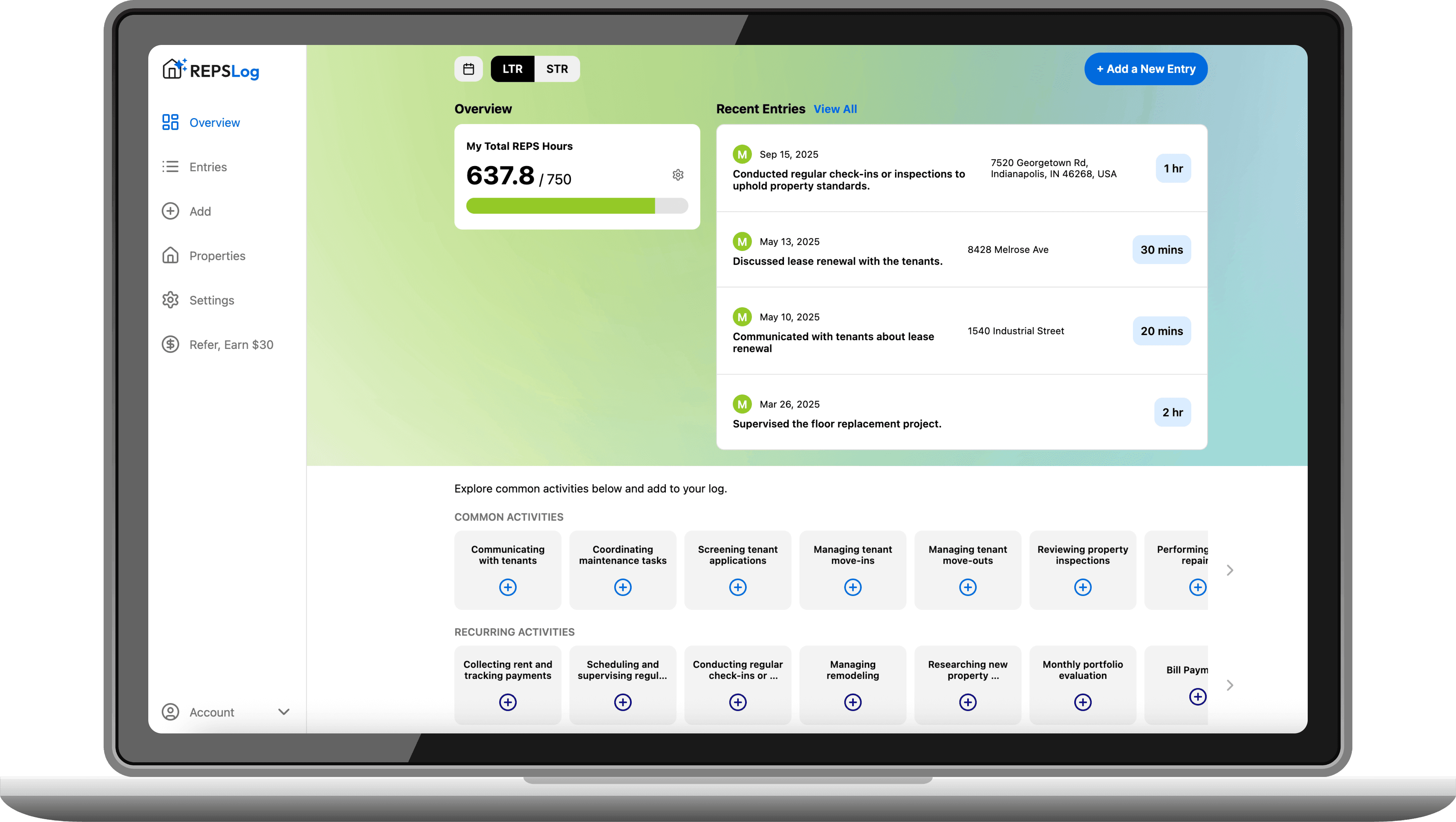
In practice, though, Tax Court cases tell a different story. Courts have repeatedly rejected vague estimates, reconstructed logs, and undocumented claims. The gold standard is a contemporaneous time log — a record created as you work, not after the fact.
What a Good Log Entry Looks Like
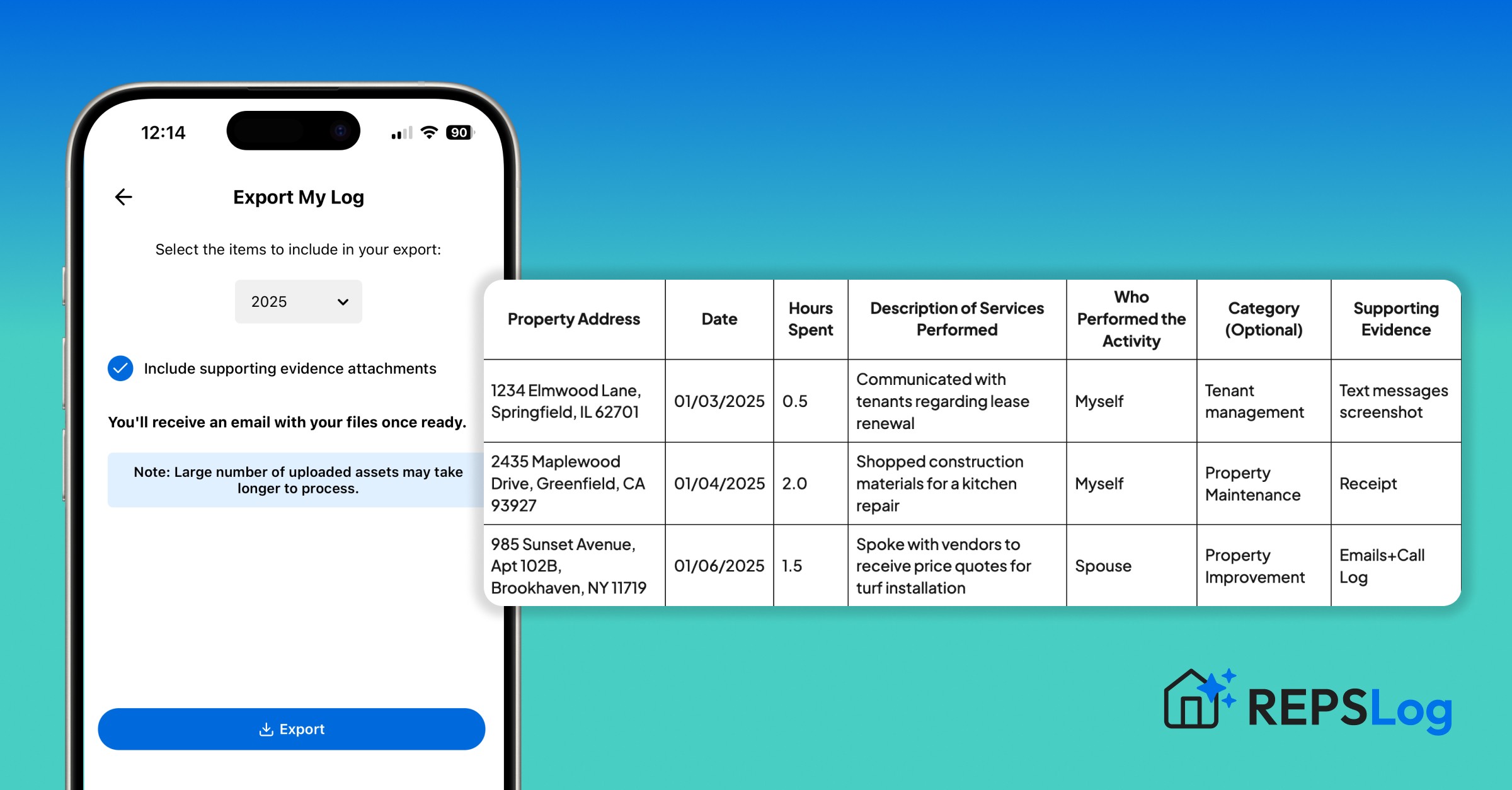
A defensible log entry includes:
Date — when the work was done
Hours — how long you spent
Property — which property the work was for
Description — what you did, with enough detail to be credible
Participant — who did the work (you, your spouse, a contractor)
Example: "April 12 — 2.5 hours at 456 Oak Ave: met with HVAC contractor to review replacement options and approve bid. 1 hour listing rental vacancy for Maple Dr. property on Zillow and responding to 3 applicant inquiries."
Supporting Evidence
Your log is stronger when corroborated by other records:
Receipts and invoices matching dates in your log
Emails and text messages with tenants, contractors, or guests
Calendar entries and appointment records
Photos from property inspections or repairs
Bank and credit card statements showing property-related purchases
Mileage logs for travel between properties
What Gets Rejected
Based on Tax Court cases, logs with these characteristics are frequently disallowed:
Vague entries like "worked on property" without specifics
Unrealistic hour claims (hundreds of hours for tasks like writing checks)
Retroactively constructed logs created during audit preparation
Duplicate or templated entries that look fabricated
Hours for activities that don't qualify (education, market research, financing)